Most grid code tests can be repeated. A poorly captured AVR step test? Run it again next shift. A speed-droop measurement that didn't settle cleanly? Repeat after lunch.
The inrush current measurement at first energization of the generator step-up transformer (GSU) is different. The transformer is energized exactly once from the de-energized cold state. Every subsequent energization carries residual flux, different ambient conditions, and (often) different system impedance behind the breaker as more of the plant comes online. If the recorder didn't capture the first event correctly, what you can re-measure later is no longer the first event.
This is the test where the most experienced engineer on the project should be the one watching the recorder.
What the data actually looks like — from a recent engagement
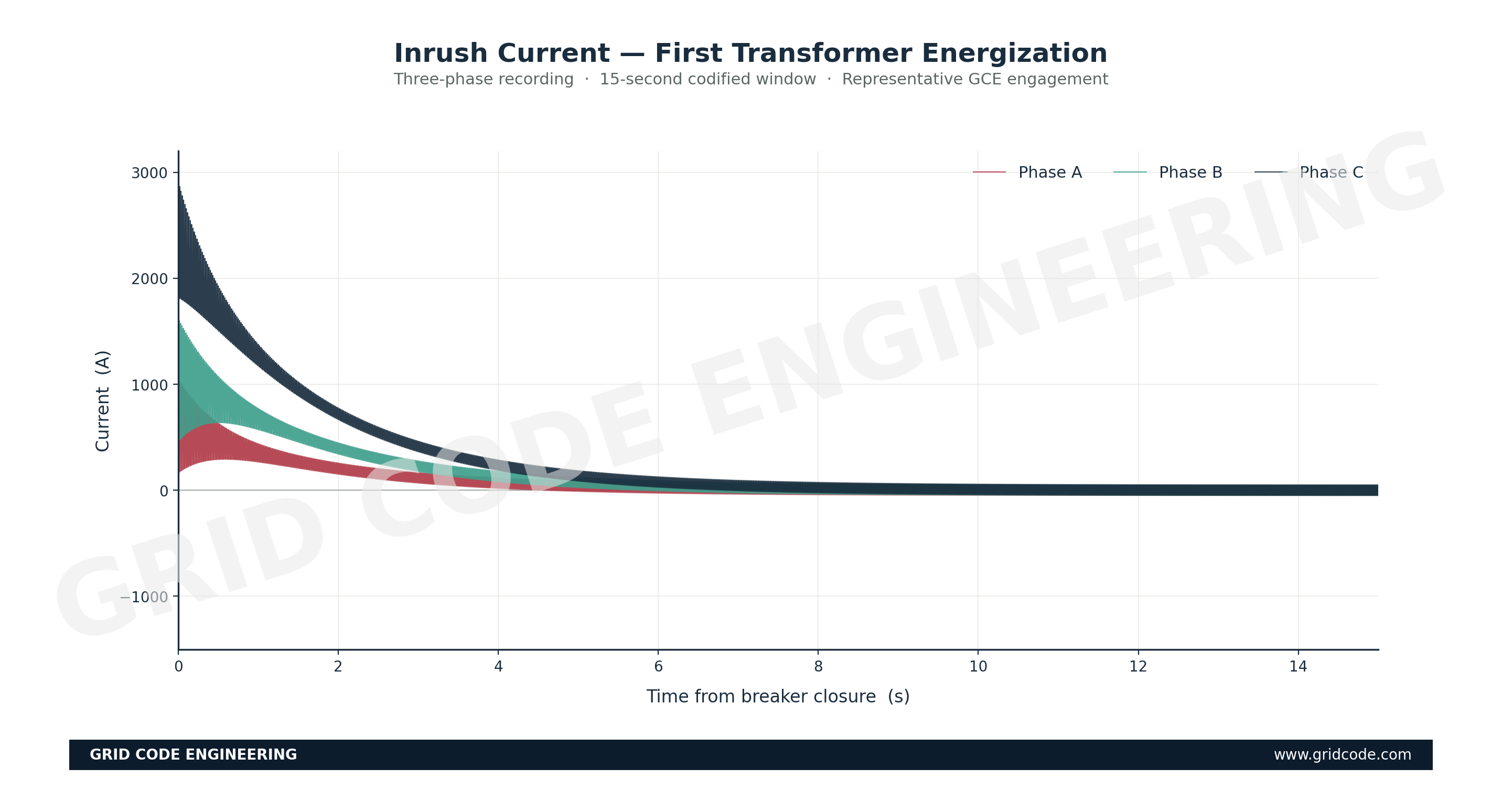
Inrush is one of those phenomena where a number on a page understates what the physics looks like. In one GCE engagement (22 October 2025), a generator step-up transformer energization produced the following on the line-side current measurement:
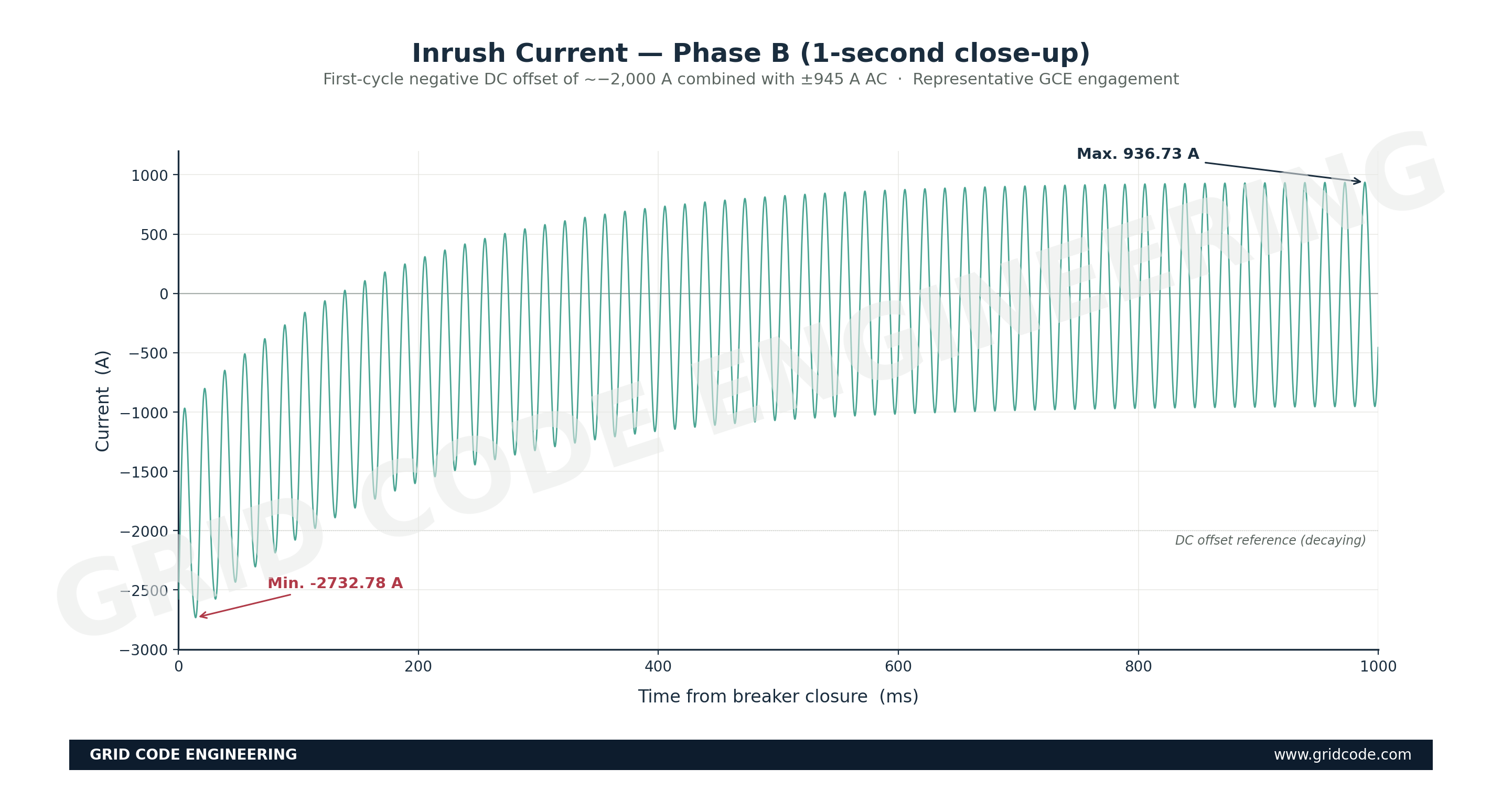
Phase A peak: +1,131 A, minimum −873 A within the first second. Phase B peak: ~1,850 A (intermediate). Phase C peak: ~2,800 A in the first half-cycle — more than 2.5× the Phase A peak.
The dramatic per-phase asymmetry is the signature of the point-on-wave at which the breaker contacts actually closed. The three phases all see the same network impedance and the same transformer; the difference between Phases A and C in this engagement is entirely a function of when, within the 60 Hz cycle, the contacts made. That asymmetry decays away as the DC component bleeds off — by ~6-8 seconds, all three phases settle into the symmetric steady-state magnetizing current.