Independent grid code testing · For global utilities, IPPs and OEMs
Home/ Behind the Grid/ Field methodology/ Speed droop testing

Speed droop testing: why the 3–7.5% setting is the most consequential dial in the plant.

Speed droop determines how much of the plant's output changes in response to a frequency excursion on the grid. Set it wrong and a single unit either dominates the primary frequency response or refuses to participate.

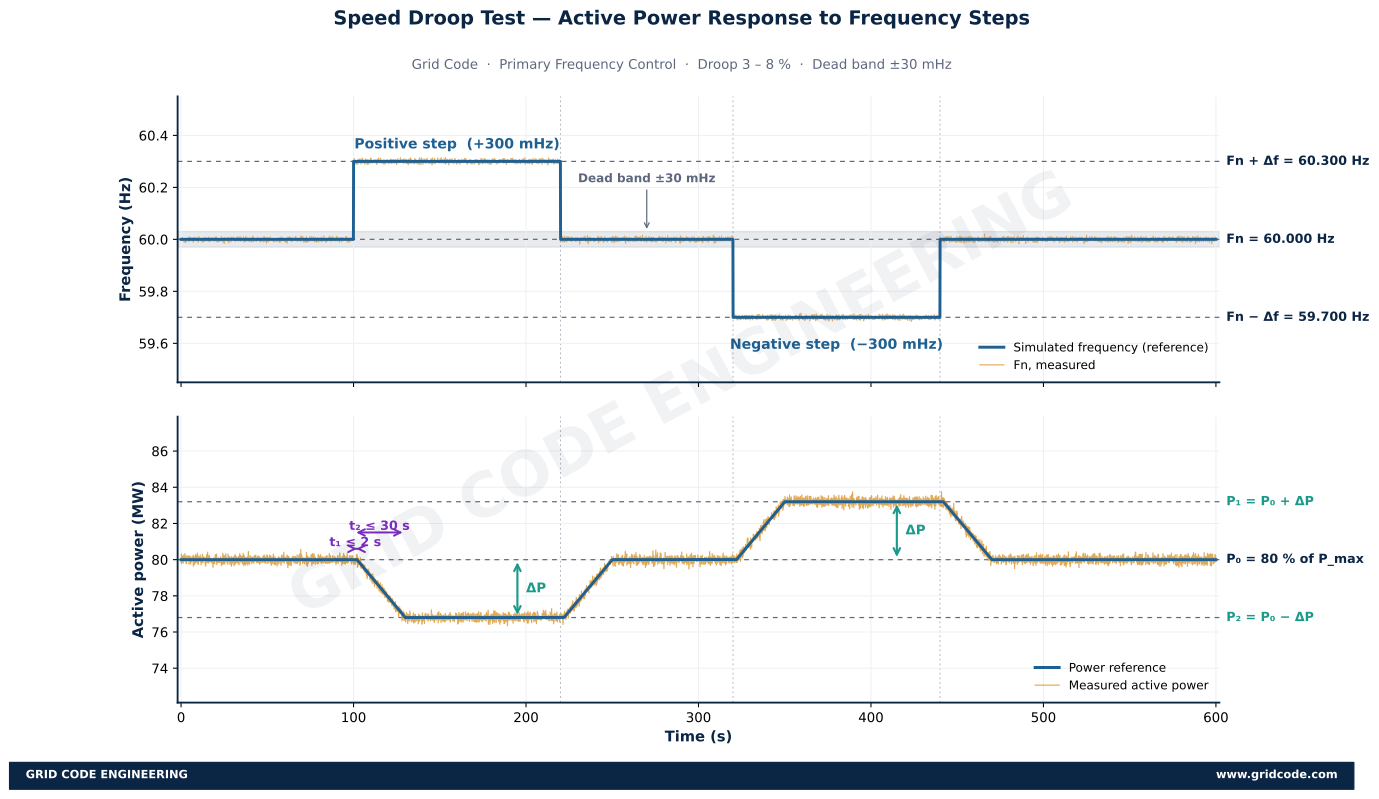
Speed-droop test waveform — frequency perturbation ±300 mHz with corresponding active-power response, 3–8% droop band and ±30 mHz deadband marked

GCE field measurement · Speed-droop test · Frequency perturbation and power response

The test sequence

Four distinct test points. One measured value of droop.

The droop test sits in the per-unit speed control family — one of approximately eleven individual tests in the Mexican framework, with comparable groupings elsewhere. The test produces a directly measured droop value, validated against the governor's nameplate setting. It runs in four variants — each isolates a different aspect of the response.

/ Test point 01
±0.05 Hz step

Small-signal response near nominal

Reference perturbed by a fraction of a percent. MW response measured over a 10–20 second settling window. Validates that the small-signal droop matches the governor setting.

Validates · Setting fidelity
/ Test point 02
±0.2–0.5 Hz step

Large-signal response

Reference perturbed by a larger value. MW response captured. Validates that the droop relationship holds across the broader response range — the governor isn't saturating, the fuel system delivers, the prime mover physically responds.

Validates · Governor authority
/ Test point 03
Min · Mid · Full load

Multi-operating-point response

Unit loaded to several power outputs across its operating range. Droop test repeated at each. Validates that droop is consistent — not a property of one operating point.

Validates · Operating-point invariance
/ Test point 04
±0.03 Hz deadband

Deadband verification

Most grid codes specify a frequency deadband — typically ±0.03 Hz — inside which the governor does not respond. Test verifies the deadband is correctly set: not so narrow that the unit chases noise, not so wide that it ignores legitimate frequency events.

Validates · Noise rejection

The governor's droop setting is a single number — typically expressed as a percentage. It sits in the governor's parameter table next to dozens of other settings. It is almost never the headline parameter in a plant's marketing material.

It is also the parameter that, more than any other, determines how that plant behaves during a grid frequency excursion — and therefore how the plant participates in maintaining the stability of the entire interconnected power system.

Why 3% to 7.5% is the codified band

Most grid codes specify an acceptable droop band for synchronous generation participating in the wholesale market. The codified band is typically 3% to 7.5% — that is the value in Mexico's Código de Red 2.0, and the same range (sometimes 2% to 8%) appears in NERC's reliability standards, ENTSO-E's European framework, Chile's NTSyCS, and most other regulated systems.

The 3% lower bound exists because anything below produces unstable inter-machine oscillations. The 7.5% upper bound exists because anything above makes the governor effectively non-participating in primary frequency response.

Inside that band, the plant operator and the regulator have legitimate engineering room to negotiate the specific setting. The choice depends on prime mover, fuel system response, control loop tuning, and the unit's economic operating point. There is no single correct answer inside the band; there are wrong answers outside it.

How the test is actually run

The unit is operated stably at a known power output on automatic governor control. A controlled frequency setpoint change is introduced at the governor reference. The unit's power output response is recorded. The ratio of the frequency change to the resulting power change (corrected for nominal values) yields the measured droop.

Why this test is the regulator's leverage

Droop is one of the few plant parameters the regulator can validate experimentally from outside the plant. The system operator cannot easily verify that a plant's claimed heat rate is what's printed in the dossier. They can verify droop because they can perturb the governor's frequency reference and watch what the unit does. That makes the droop test one of the most rigorously reviewed items in the field campaign.

Cogeneration HRSGWhere droop response meets the prime-mover's physical limits

What goes wrong.

×

Setting and measured droop don't match

Governor logic has a multiplication factor or unit conversion. Displayed 5% turns out to be operationally 6.2%. Either direction is a finding the regulator documents.

×

Fuel system can't deliver the demanded change

Gas supply constraints, single-source feed, or combustion engine asymmetry. Measured droop is degraded against the setting.

×

Deadband set wrong

0.1 Hz deadband means the unit fails to respond to a 0.06 Hz event that the regulator expected participation in. Unit appears non-responsive.

×

Unit on isolated control mode

Some plants run governors in modes that don't respond to grid frequency. Legal in certain market categories — but must be declared, not assumed.

A clean droop dossier means the plant has demonstrated, with millisecond-grade evidence, that it will participate in primary frequency response correctly when the grid asks it to. That demonstration is the price of operating in any regulated wholesale market.

Verify against published regulation

The codified droop range (typically 3.0% to 7.5%), the codified frequency deadband (±0.03 Hz in the Mexican framework), and the codified test step magnitudes should be confirmed against the active grid code for the jurisdiction in question (Manual de Operación in Mexico, NERC reliability standards in the US, ENTSO-E Network Code in Europe, NTSyCS in Chile, etc.). The values used in this post reflect Mexican practice and broader industry convention; precise codified numbers should be confirmed in the operation manual or equivalent published procedure.

Need droop testing on a unit approaching commercial operation?